Costuming Pregnancy: Outlander
- Chelsea Phillips

- Jul 28, 2019
- 3 min read
I was recently re-watched the second season of Outlander, which is about a woman who travels back in time to 1740s Scotland and gets swept up in the 1745 Highland Rising.
I enjoy the show and the books, as much for the history lessons as for anything else. The main character was a combat nurse in WWII, so there's a lot of conversation about herbs, remedies, and the kinds of medical resources available in the mid-18th century. Plenty of people hate this (about the books especially), but of course it's right up my alley.
In the second season we see Claire, the main character, living abroad in Paris. She's pregnant with her first child, who is sadly stillborn. In the books, she's about five months pregnant when this happens; the timeline on the show is less clear.
Watching the evolution of her pregnant body over the first part of the season, I was struck with how frequently when she was fully dressed the pregnancy wasn't obvious visually, but instead made visible with gestures like a hand on the belly. What was a fairly significant bump under her shift became mostly invisible under many layers of structured clothing. I wondered if there were times, particularly in early episodes, when they were simply leaving the prosthesis off--the poor actress is probably already in 30 pounds of clothing on a good day, give her a break!
So I did some looking and came across an interview with the costume designer. She said they had to give the actress a larger-than-normal prosthesis in order to have the belly read for audiences under the clothing. "It's just physics!" she said.
Solving that problem took a little bit of creativity and a whole lot of baby bump tests. "It really was just a question of taking what would be normal clothes and finding ways to structure them a little bit different so it would show. But we had many many, many baby bump tests. It looks like she's seven or eight months pregnant and in the story she's only four months pregnant, because otherwise, no one would know she was pregnant in her clothing, so we had to go a little bit bigger than we might have normally done so people could actually see it." (read more)
This is a particularly good show for thinking about the topic, as the costume designer and her team do a phenomenal job of rendering accurate clothing from the skin out. In the first season, we see a pregnancy that is much more visible. This makes sense, since it's supposed to be further along and the costume was simpler, with less fabric to swell out and disguise the shape. The visibility of Claire's bump shifted radically with clothing style. When she wore shorter-waisted dresses, it was obvious. Longer lines and panniers accentuating the hips, not as much until the character had to move quickly and put a hand to her stomach. It would vary greatly with your body size and proportion as well, I would guess, as well as how you high you carried your child. It's also a TV show, so we weren't always seeing her full length or from the side.

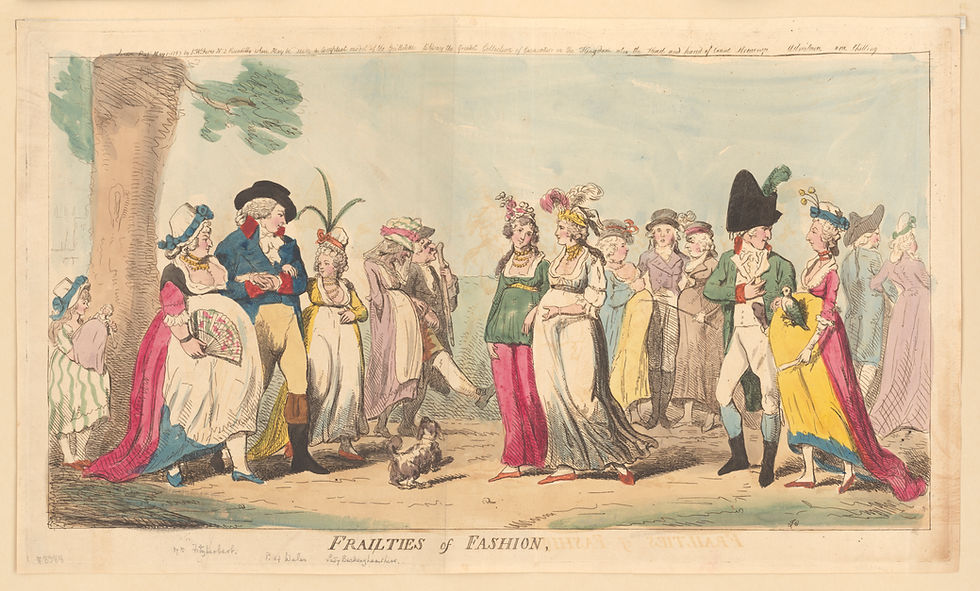
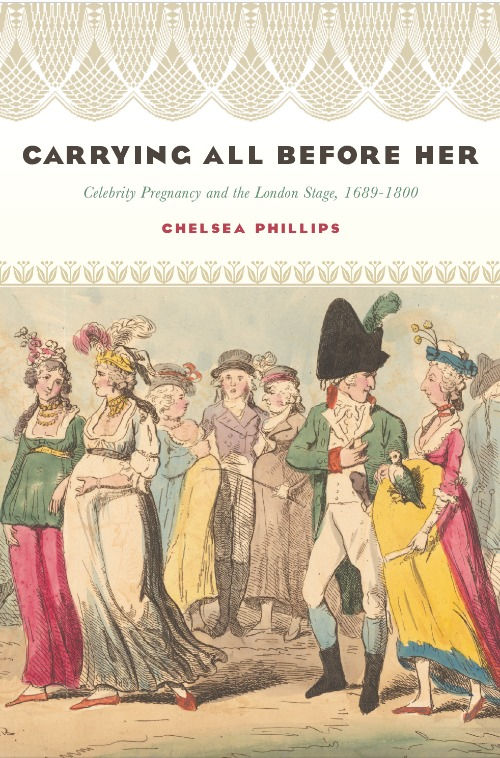
The show is set in the mid-18th century, and the clothes were BIG. Sixty or so years earlier, waists were short enough and skirts voluminous enough that women in portraits often look pregnant even when they weren't. Forty or so years after this, neoclassical styles sweep the continent and suddenly everything gets MUCH more obvious.
What is true is that, as Terry Dresbach mentions, there wasn't really a concept of maternity wear in the century. There were maternity stays, with extra lacings that could be let out to accommodate a changing body, but your actual clothing pretty much stayed the same and was let out as needed. Some women did wear radically different styles, such as riding cloaks, or saque back gowns, which fell straight to the floor from the shoulders. Conceal a belly they did, but when you suddenly started wearing them, people knew why. Other women took a more eccentric approach such as wearing their husband's dressing gowns or layers of shawls instead of their regular clothing.
Then as now, women took individual approaches to dressing their bodies, and the second season of Outlander is a good look at the different effects these mid-century styles could have.

Comments